


[Pet Dentistry] Is Teeth Cleaning Enough? The Critical Step Before Accurate Treatment: Dental Radiography (Xray)


Many pet owners frequently complain that their dogs develop dental issues or severe halitosis (bad breath) shortly after a professional teeth cleaning. There is a clear clinical reason for this.
Superficial dental scaling can only resolve mild cases of gingivitis.or early periodontal disease. However, many canine and feline dental issues are far more complex than mere gum inflammation. Pets often suffer from severe periodontal disease, tooth resorption, fractured teeth, or deep root infections—problems that scaling alone can never resolve.
More importantly, without the diagnostic aid of dental X-rays, these critical conditions remain completely invisible, allowing the disease to be prolonged and worsen over time. The clinical photos shared in this article are intended to help owners understand the scientific reasoning and absolute necessity behind dental radiography.
Why Do Many Vets Only Perform Scaling and Skip X-Rays?
To be blunt, many veterinarians limit their dental treatments to cosmetic scaling without taking X-rays. This diagnostic gap usually occurs due to a few stark realities within the industry:
Lack of Dental X-Ray Equipment: These specialized units are usually expensive. Only high-definition X-rays can reveal subtle bone loss and root pathology, yet many clinics choose not to invest in this equipment.
Lack of Technical Training: Capturing accurate dental radiographs requires precise technique and clinical skill. This is a specialized area not thoroughly taught in standard veterinary school curricula. Without dedicated post-graduate continuing education, a vet might not be able to take proper X-rays to accurately diagnose and treat dental diseases.
To Avoid Extra Trouble: Simply put, if you don't take an X-ray, you can't see the problem. If you can't see the problem, you can say there isn't one—and if there is "no problem," there is no need for further complex treatment. To save time and avoid hassle, some operators choose to skip radiographs entirely, taking an "out of sight, out of mind" approach. Consequently, many owners are left completely unaware that their pet is living with chronic dental pain.
Why Are Dental X-Rays So Critical? The Devil Is in the Details!
When you open a pet's mouth, the visible portion of the tooth—the crown—only accounts for about 1/2 to 1/3of the total dental structure. The remaining vital roots are anchored deep within the alveolar bone and completely obscured by the gingival tissue (gums). Without the assistance of X-rays, it is physically impossible to evaluate the condition of the roots and the supporting jawbone.
Anyone who has visited a human dentist knows that dental X-rays are a mandatory baseline required to evaluate dental health before any extraction or treatment. Animals are exactly the same.
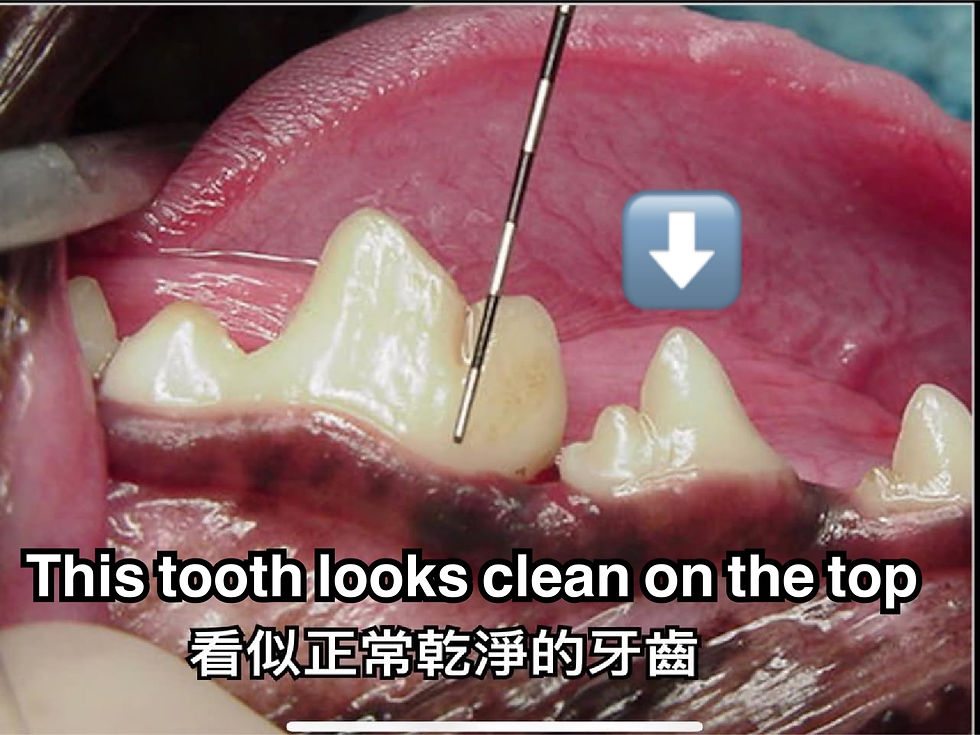
As you can clearly see from the explanatory photos provided, without radiographic imaging, many teeth that appear perfectly healthy on the surface are actually suffering from severe decay underneath. Therefore, if you want a true, accurate assessment of your pet's oral health, never settle for just a superficial teeth cleaning.


The devil is in the details. Believing that a simple cosmetic scaling will fix an entire oral crisis will only mask the infection, allowing the problem to become progressively worse under the gumline.
The professional content above is authored by Dr. Ryan Chuang. All rights reserved.
🏥 Appointments & Inquiries
For any medical needs or assistance, please contact Paws and Tails Veterinary Hospital:
Phone:+852 2832 2836
WhatsApp:+852 9870 5711
Website:www.pawsandtailshk.com
Address:4 Po Yan Street, Sheung Wan, Hong Kong


Comments